For decades the rule was simple: lasers for thin sheet, plasma for thick plate. Ultra-high power fiber lasers have broken that rule. Sources of 20, 30, and 40 kW are now common in steel service centers and heavy fabrication, and market reports describe the segment above 12 kW as the fastest-growing part of the laser cutting market. This guide looks at where the line between laser and plasma sits today, by thickness, by edge quality, and by cost.
If you need the basics of how the 2 processes differ first, the overview of laser cutting machines vs plasma cutting machines covers the fundamentals. This article focuses on the thick plate decision.
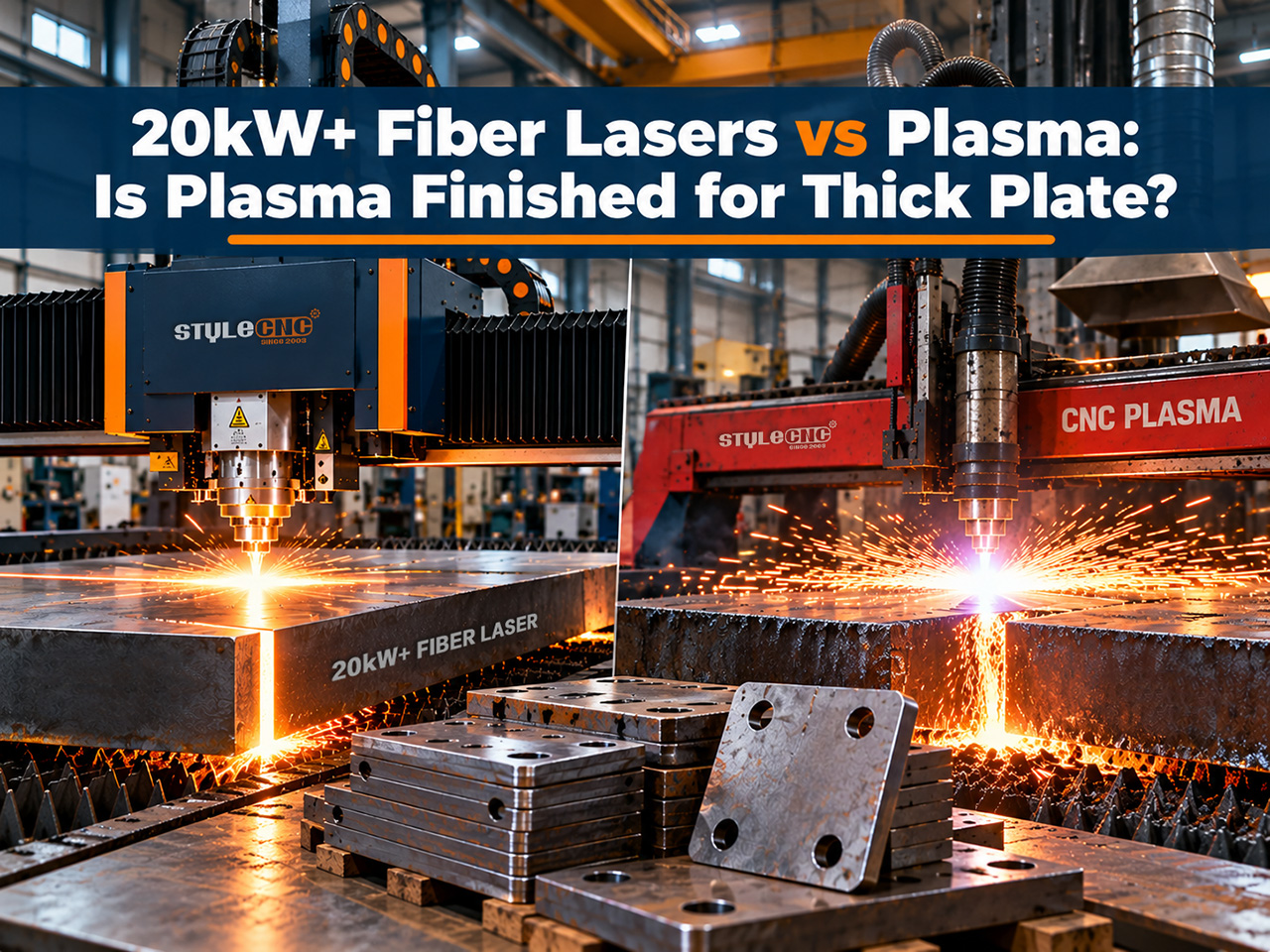
Where 12 kW Fits in the Debate
A 12 kW fiber laser is where most shops 1st meet the plasma question. At this level, lasers handle medium plate comfortably and cut into the thick band at slower speeds, which makes 12 kW a common step up for fabricators whose work is mostly under 20 mm with occasional heavier parts.
Above 12 kW, the machine changes character. Sources of 20 kW and more need heavier frames, larger chillers, stronger extraction, and a bigger electrical supply, so the buying decision becomes a facilities decision too. That is why many shops treat 12 kW as the upper end of general fabrication and 20 kW and above as a dedicated thick plate investment.
Thickness-to-Speed Comparison
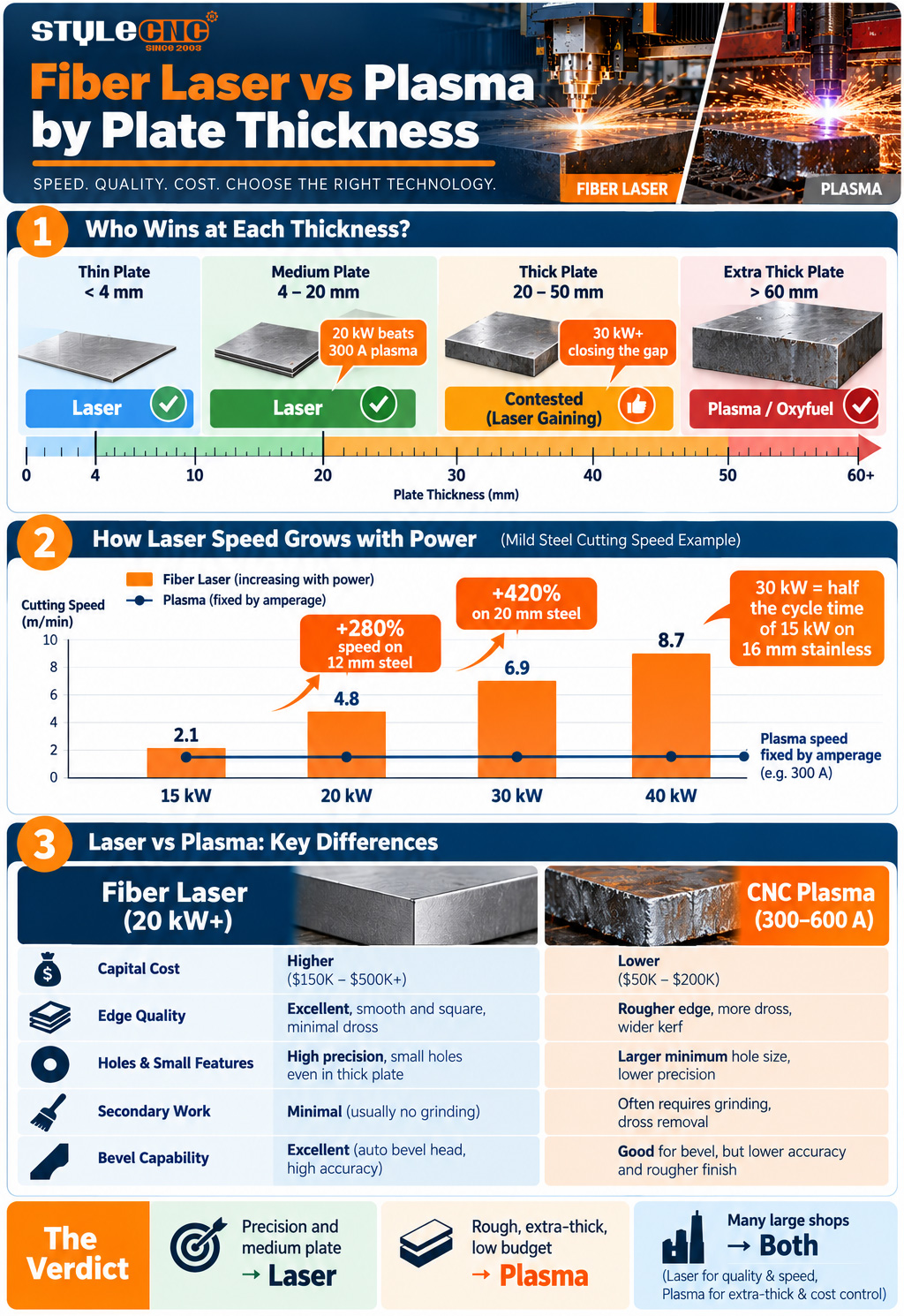
Fabricators usually group steel plate into 4 bands: thin under 4 mm, medium from 4 to 20 mm, thick from 20 to 60 mm, and extra thick above that. The laser versus plasma answer changes in each band.
| Plate Thickness (carbon steel) | 20 to 40 kW Fiber Laser | Plażma ta' Definizzjoni Għolja | Usual Winner | Kejl |
|---|---|---|---|---|
| Thin, under 4 mm | Very fast, fine detail, minimal heat | Fast but wider kerf and more heat distortion | Laser | Parts per hour and flatness after cutting |
| Medium, 4 to 20 mm | A 20 kW laser outpaces a 300 A plasma up to about 20 mm | Competitive speed, rougher edge, bevel on cut face | Laser | Cut meters per hour at production quality |
| Thick, 20 to 50 mm | 30 kW and up closes the gap with air or oxygen | Long-standing speed leader in this band | Contested; laser gaining | Total cycle time including secondary cleanup |
| Extra thick, over 60 mm | Possible at 30 to 40 kW, slower and specialized | Practical up to its rated pierce limit | Plasma or oxyfuel | Pierce reliability and edge squareness |
The important shift is how strongly laser speed scales with power. Published cutting trials on ultra-high power sources show speed rising steadily all the way to 40 kW:
⦿ Moving from 15 kW to 40 kW raised cutting speed on 12 mm carbon steel by about 280 percent, and on 20 mm carbon steel by about 420 percent.
⦿ A 30 kW laser cut a typical 16 mm stainless part in half the cycle time of a 15 kW laser, which also halved the gas used.
⦿ On 50 mm carbon steel, one manufacturer reports a 30 kW machine running about 88 percent faster than a 20 kW machine.
⦿ In pulsed mode, trials have cut 70 mm stainless with nitrogen at 30 kW and 230 mm carbon steel with air at 40 kW, though those are capability demonstrations rather than everyday production speeds.
Plasma does not scale the same way. A plasma system is limited by its amperage, and its speed on a given thickness is largely fixed once the power supply is chosen. That is why the medium plate band, once shared, now belongs mostly to lasers, and why the thick band is being contested. The full speed envelope by power level is mapped in the Gwida għall-ħxuna, il-veloċità u l-qawwa tal-metall għat-tqattigħ bil-lejżer bil-fibra.
Air cutting changes the thick plate economics
A less obvious factor is the assist gas. Oxygen cutting of thick carbon steel works well at lower power but its speed barely improves as power rises. High-pressure air cutting scales with power, and at 20 kW and above it cuts thick carbon steel quickly and largely free of dross. That means an ultra-high power laser can cut thick plate faster and at a lower gas cost than older oxygen processes, which narrows plasma’s cost advantage as well as its speed advantage.
Piercing thick plate
Piercing is often the hidden bottleneck on thick plate. Plasma pierce capacity is set by the power supply, and parts beyond it need edge starts, which limits nesting. High-power lasers pierce thick plate faster than they once did, but piercing still takes noticeably longer than on thin sheet and adds spatter that wears nozzles. On parts with many holes, pierce time can outweigh the difference in cutting speed, so count pierces as well as cut length when comparing quotes or trial results.
Bevel and Edge Quality
Speed alone does not settle the argument, because thick plate parts usually go on to welding or bolted assembly. Edge quality decides how much work is left after the cut.
⦿ Kerf and heat: a laser kerf is narrow and the heat-affected zone is small; plasma leaves a wider kerf and more heat input, which can distort thinner sections.
⦿ Edge angle: plasma cuts carry a slight bevel on the cut face, while laser edges on medium plate are much closer to square.
⦿ Holes: lasers cut small, round bolt holes in medium plate that are often usable straight off the table; plasma holes in thick plate commonly need drilling or reaming.
⦿ Weld preparation: plasma bevel heads are mature and widely used for V and K preparations on thick plate, and laser bevel heads are now available but add cost.
Fabricators describe the practical difference in their own terms: if every plasma-cut base plate goes to the drill and the grinder before welding, the cut was not really finished. Structural base plates in the 12 to 40 mm range are one of the clearest examples of work moving from plasma to laser for exactly this reason. Shops running this kind of structural and plate steel work often find the saved secondary labor matters more than the cutting speed.
Material type shifts the picture too. Stainless and aluminum thick plate favor the laser more strongly than carbon steel, because nitrogen laser cutting leaves a clean, oxide-free edge that plasma cannot match without extra finishing. On thick carbon steel, where plasma edges are acceptable for many structural uses, the contest stays closest.
Capital Cost vs Throughput
This is where plasma still holds its strongest ground. An ultra-high power laser is a major investment, while a capable plasma system costs a fraction of the price.
| Fattur | 20 to 40 kW Fiber Laser | Sistema tal-Plażma CNC | Kejl |
|---|---|---|---|
| Spiża kapitali | High; often well into 6 figures with chiller and enclosure | A fraction of the laser price, even for high-definition systems | Total installed cost per machine |
| Domanda elettrika | Large; around 50 kW installed at 12 kW and more above it | Power supply sized by amperage | Installed kW and utility upgrade cost |
| Throughput on 4 to 20 mm | Highest of any thermal process | Lower, with more secondary cleanup | Finished parts per shift |
| Xogħol sekondarju | Little; edges and holes often ready for assembly | Grinding, drilling, or reaming common on precision parts | Labor minutes per part after cutting |
| Konsumabbli | Nozzles and protective windows | Electrodes and nozzles, frequent at high amperage | Consumable cost per cut hour |
The decision comes down to utilization. A 20 kW or larger laser running 2 shifts of medium and thick plate can repay its premium through throughput and saved finishing labor. The same machine running a few hours a week on occasional thick parts will not. Before committing, compare the total installed cost, including power upgrades and chiller capacity, against the extra parts per shift it delivers. Equipment pricing is covered in kemm tiswa magna tal-qtugħ bil-lejżer, and plasma pricing in Kemm tiswa mejda tat-tqattigħ tal-plażma.
Shops that do justify the investment usually look at heavy-frame magni tal-qtugħ tal-metall bil-lejżer tal-fibra ta' qawwa għolja built to carry thick plate loads and the higher heat of long cuts, rather than lighter sheet-metal frames fitted with a bigger source.
Spiża operattiva għal kull metru
Hourly running cost favors plasma, because an ultra-high power laser draws far more electricity and needs a larger chiller. Cost per meter of cut can tell a different story. When the laser cuts medium plate several times faster, uses air instead of nitrogen, and removes a grinding step, its cost per finished part can fall below plasma even though its hourly cost is higher. The comparison only holds if the machine is kept busy, which brings the decision back to utilization.
Who Should Still Buy Plasma
Plasma remains the right answer for a large share of buyers. It makes sense when:
⦿ The work is mostly rough structural cutting where edge finish and hole accuracy are not critical.
⦿ Plate regularly exceeds 50 mm, or the shop needs oxyfuel as well for very heavy sections.
⦿ Budget or available electrical supply rules out an ultra-high power laser.
⦿ Weld bevels on thick plate are a daily requirement and a proven plasma bevel head fits the workflow.
⦿ Machine hours are too low to repay a laser’s capital cost.
For these shops, a heavy-duty gantry plasma cutting machine delivers thick plate capacity at a much lower entry cost, and a CNC plasma table with a flame cutting torch adds oxyfuel for the heaviest sections. Many larger fabricators now run both: a high-power laser for precision and medium plate, and plasma or oxyfuel for the thickest and roughest work.
Lista ta' Kontroll tad-Deċiżjonijiet
✔ Sort a year of jobs by thickness band and count the hours in each.
✔ Measure secondary work on current plasma parts: grinding, drilling, and rework minutes per part.
✔ Price the laser with chiller, enclosure, power upgrade, and installation, not just the machine.
✔ Compare finished parts per shift, not cutting speed alone.
✔ Keep plasma or oxyfuel in the plan if extra thick plate is a regular part of the work.
Compare Laser and Plasma for Your Plate Work
Explore high-power Magni tal-qtugħ bil-lejżer tal-fibra flimkien Cutters tal-plażma CNC, and get a free quote based on your plate thicknesses, volumes, and finishing requirements.